Liposomes
Fast, efficient and innovative nutrient transport system
The history of liposomes dates back to the 1960s, when they were first discovered by British hematologist Alec Bangham in a study of blood clotting. He and his colleagues saw that phospholipids, the main building blocks of cell membranes, could form bilayers in water. This discovery laid the foundation for the development of liposomes. Since the first description of liposomes, these ‘fat vesicles with content’ have attracted a lot of interest from the pharmaceutical industry, especially as advanced drug delivery systems due to their ability to encapsulate both hydrophilic and lipophilic substances.

What does liposomal mean?
In our liquid liposomal food supplements, the active vitamins and minerals are packed in a fat globule (the liposome) that consists of a double layer of so-called phospholipids. The size can vary from a few to tens of micrometers. A phospholipid can contain both hydrophilic and lipophilic substances. Cell membranes in the body, like the membranes of liposomes, are made up of a double layer. The moment the liposome comes into contact with the cell membrane, they fuse into one, releasing the contents of the liposome into the body cell.

Fusion liposome(l) with the human cell(r).

Liposomes are resistant to digestive enzymes, stomach acid, and bile juices. The active ingredients, such as vitamin B12, are thus protected, released into tissues and cells and particularly well absorbed by the body. The use of liquid liposomal dietary supplements quickly results in increased levels of active nutrients in the body, effectively giving these products a ‘boost’.
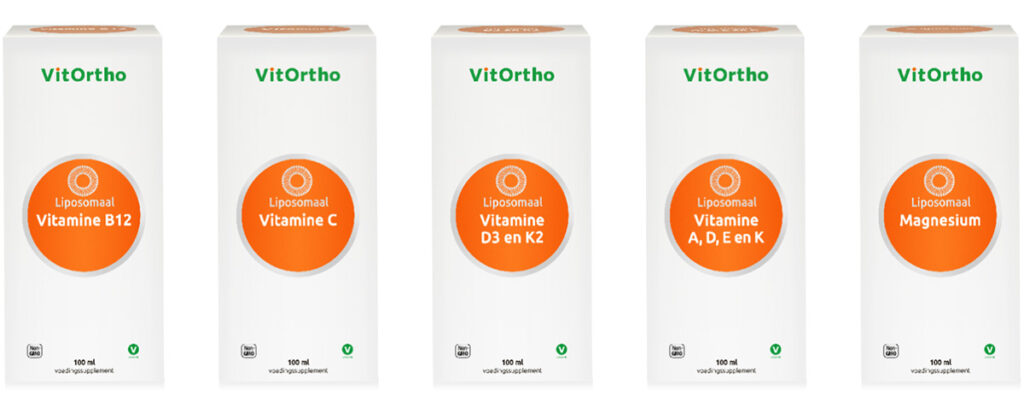
Liposomal food supplements
VitOrtho’s liposomal food supplements are extremely easy to take due to their liquid form and therefore ideal for people who have difficulty swallowing tablets or capsules.