
The many faces of calcium
The way to our daily allowance of this essential mineral
Calcium is an important mineral for humans. Among other things, it contributes to the maintenance of strong teeth and bones. No less than 99% of the body’s supply of calcium is found in the skeleton and teeth. In our body you will find as many as 206 bones. Between the ages of 20 and 30, these bones reach maximum mass. After that, the activity of the osteoblasts (bone building) decreases and the osteoclasts (bone breakdown) increases.

The Netherlands dairy country
The Netherlands is still a major dairy producer. Every year, about 14 billion kilos of milk are processed into calcium-rich dairy products such as milk (products), cheese and yoghurt. But times are changing and so are the diets. The current trend shows that more and more people are opting for plant-based dairy substitutes and reducing their consumption of animal products, which affects the intake of calcium.
To illustrate
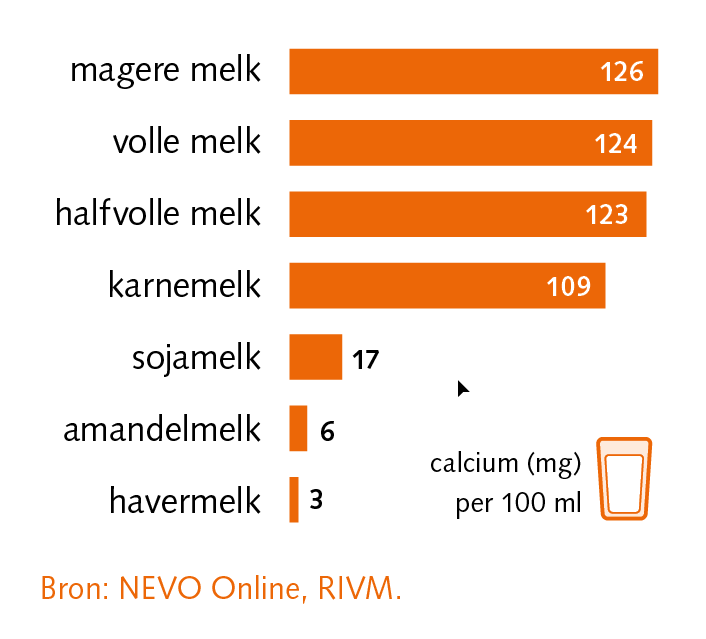
Whole cow’s milk contains 124 mg of calcium per 100 ml, but plant-based alternatives – such as the oat milk that is popular today – contain considerably less. The risk of a calcium deficiency is certainly not imaginary.
Fortunately, there are a number of generous plant-based calcium suppliers, such as kale, white beans, and certain nuts and seeds.
Research
A recent publication in The Lancet Global Health* paints a worrying picture of nutrient deficiencies worldwide: more than 4 billion people do not get enough essential nutrients, such as iodine, vitamin E and calcium. If we keep the focus on calcium, 66% of the world’s population appears to be deficient in calcium. The Dutch media responded to this with the message that “we don’t have to worry”.
Admittedly, large parts of the world are unfortunately struggling with a structural shortage of food and there is little variety. As a result, most of the population in these areas is deficient in important micronutrients, including calcium. In our regions, this percentage is ‘only’ 30-35%, but that still means that a third of the inhabitants of ‘the Netherlands dairy country’ do not get enough calcium. That is about 6 million people ‘who should not worry…’.
Downplaying such strong evidence from research shows a lack of understanding of the impact of nutrient deficiencies on health. After all, a calcium deficiency can indeed affect the normal functioning of humans. After all, calcium fulfills other important tasks in our body. For example, it plays a role in the cell division process and is important for the nervous system: it contributes to normal stimulus transmission in the nerves.
Other sources of calcium
Dietary supplements can help with the absorption of calcium. Mineral compounds in dietary supplements come in different types and qualities. Organically bound minerals (citrate, gluconate, malate, picolate, bisglycinate etc.) are generally more easily absorbed. If you choose calcium in an organic compound, you are assured of better absorption. To optimize the absorption of calcium in the bones, it is important to ensure that you get enough vitamin D3 at the same time. In addition to calcium, vitamins C, D and K2, magnesium and zinc, among others, are also good for the skeleton.
Calcium 4 in 1
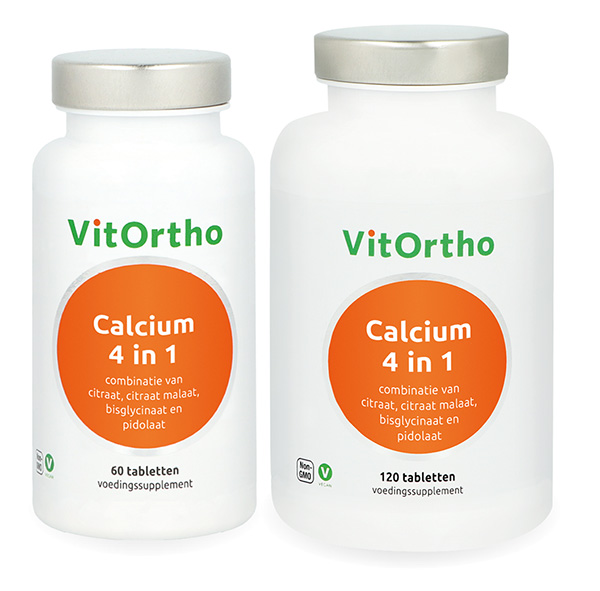
The Calcium 4 in 1 dietary supplement from VitOrtho combines the following four easily absorbable calcium forms:
- Calcium citrate is a well-absorbable compound that is recommended after bariatric surgery, among other things. People who have undergone such a procedure produce less or no stomach acid.
- Calcium pidolate has a very good absorption capacity in the body and easily enters the cells.
- Calcium bisglycinate is a special mineral amino acid chelate, in which calcium is bound to the amino acid glycine in two places. This chelated form of calcium is easily absorbed by the body. One of the reasons for this is that a mineral amino acid chelate is seen by the body as an amino acid and not as a mineral. Since several minerals use the same transporters, the absorption of one mineral can limit the absorption of another mineral. Calcium bisglycinate (and other mineral amino acid chelates) is therefore not limited in intake by this competition.
- Calcium citrate malate is a form of calcium that has a high bioavailability because the calcium is bound to citric acid and malonic acid (malic acid). It has a high water solubility which makes it dissolve easily in the stomach compared to other forms of calcium.
* Global estimation of dietary micronutrient inadequacies: a modelling analysis (thelancet.com)