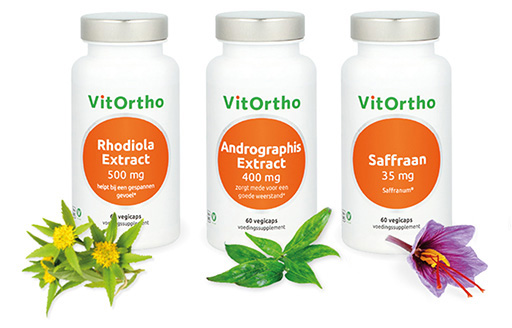
Powerful herbs
From seasoning to standardised food supplement
Herbs are not only known as seasonings in the kitchen, they also have a special reputation as useful components in natural medicine. In Ayurveda and traditional Chinese medicine, herbal extracts have been used for thousands of years for all kinds of ailments. This has led to the form of medicine we call phytotherapy. This name is derived from the Greek words phython (plant) and therapeia (cure). The Greek physician Hippocrates is not only seen as the founder of our modern medicine, but also of phytotherapy.

Development of phytotherapy
The use of herbs has long been based on experience, with the therapeutic effect of the plant often discovered by chance. With the development of chemistry at the end of the 19th century, knowledge about active ingredients grew, with the result that the useful substances from plants could be identified and isolated; Think, for example, of codeine, which is found in the poppy and is used as a cough medicine and painkiller.
The most commonly used parts of a plant are the roots, bark and leaves, sometimes also the buds, flowers or fruits. There are different methods of preparation and forms of administration in herbal medicine: a plant or parts of it are boiled in water and then applied in a tea, compress or bath. In addition, you have infusions on cold water or alcohol and it is possible to dry a herb and then grind it into a fine powder that can also be used to make herbal supplements.

The powerful herbs of VitOrtho
Herbs come in different shapes and forms in dietary supplements. For example, you have simple herbal extracts with a fixed amount of one active ingredient of a plant. Or total (complete) herbal extracts that contain all the components of a plant in the proportion that occurs in nature. In modern phytotherapy, the whole plant is preferred because of the synergistic properties of the ingredients, which often have a different effect than one component alone.
Herbal extracts
Herbal extracts are made by adding herbs to a solvent. Think, for example, of water, alcohol, vinegar or glycerine. The liquid extract that remains contains many of the active ingredients of the plant. The solvent can be removed by evaporation, leaving a dry extract. The low moisture percentage (max. 5% moisture) is good for the shelf life and quality, making it very suitable for use in a supplement.
Concentrated herbal extracts
A step further are concentrated herbal extracts with the advantage that more of a plant or herb fits in a capsule or tablet. So more effective substances per dose. For example, 250 mg of a 50:1 herbal extract contains as many active compounds as 12.5 grams (50 x 250 mg) of the original herb. As a result, you have to swallow fewer pills or capsules than with a regular extract. This is especially useful for herbs where high doses are necessary for the intended result.
Standardized herbal extracts
But it can be even better: standardized extracts. Standardization guarantees that each tablet or capsule contains the same level of one or more active ingredients of a herb. The amount of active ingredients per plant can vary and depends on various factors: location, climate and soil type play an important role in this. Just like further processing, storage and transport and exactly which part of the plant is used or how old the plant is when harvested. For example, it is known that St. John’s wort has the highest content of hypericin just before the plant flowers. With standardized extracts, you are therefore assured of a constant amount of certain active ingredients with each pill or capsule. This can be important for therapy.
VitOrtho’s standardized herbal supplements
Knowledge is therefore important when advising and using herbal supplements. VitOrtho’s high-quality, standardized herbal supplements comply with European regulations.